The 2030 Employee Passport: What If Your Skills, Trust Score and Work History Traveled With You Across Every Company?
Explore the future of work with an AI-verified employee passport that carries your skills and trust score across jobs.
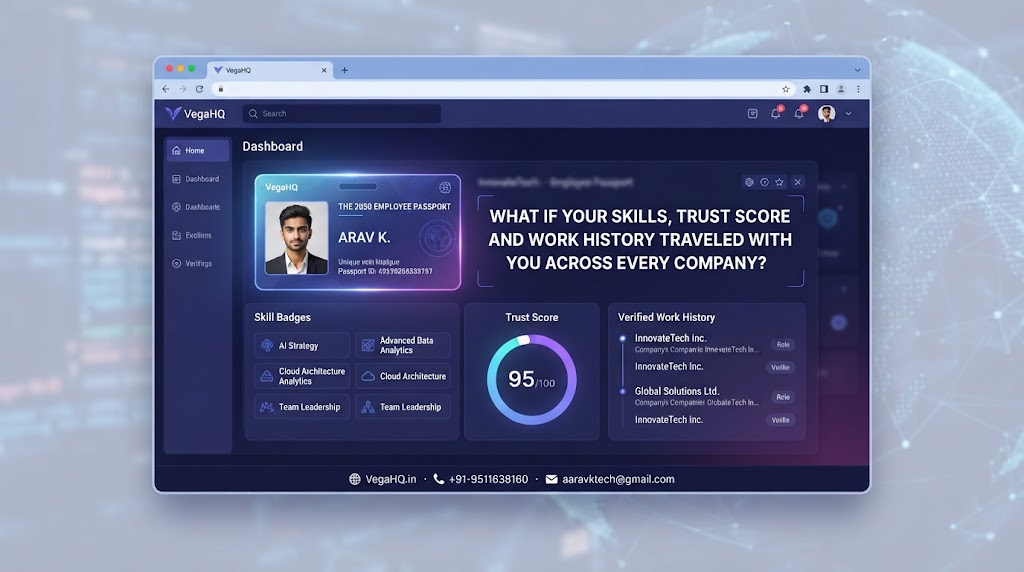
The 2030 Employee Passport: A New Way to Think About Work Identity
Every time someone changes jobs, their entire professional trust gets reset to zero. New company, new background checks, new probation period, new proof that they're reliable. It's inefficient, and it's a problem HR technology hasn't fully solved yet. Here's a thought experiment worth sitting with: what if that trust never had to reset at all?
01Why work identity is stuck in silos
Right now, your attendance record, performance history, verified skills and manager feedback all live inside whichever company's HR system you happen to be using. The moment you leave, that data effectively disappears from your career, even though it's genuinely yours. Every new employer starts the verification process from scratch.
02What a portable passport could look like
Imagine an AI-verified profile that holds your real work history, skill assessments and a trust score built from actual performance data, not self-reported claims. When you apply somewhere new, that employer could see a verified snapshot instantly. Onboarding shrinks from weeks of paperwork and reference checks to days, because trust is already established.
03Why AI-powered HRMS platforms are the natural foundation
Platforms like VegaHQ already unify attendance, payroll, recruitment, performance and compliance data in one place, across multiple companies through white-label and multi-company support. That's precisely the kind of infrastructure a portable work identity would need to run on. The pieces are already being built, even if the industry hasn't connected them into a single passport yet.
04What this could mean for hiring and mobility
For employers, it means faster, more confident hiring decisions. For employees, it means their reputation and skills become a real asset they carry forward, not something they have to re-prove every two or three years. For the broader labor market, it could mean less friction, fewer redundant background checks, and career mobility that actually rewards consistency.
05My take
We're not there yet, and there are real questions to work out around data ownership, privacy and who controls the passport. But if you're evaluating HR platforms today, I'd lean toward ones already built on unified, AI-driven data architecture like VegaHQ, rather than fragmented point solutions. When portable work identity does arrive, and I think it will within the next several years, the companies already running on connected systems will adapt fastest. The ones still stitching together five different tools will be starting from scratch, again.
Give HR its AI upgrade
Attendance, payroll, performance and recognition — unified, automated and always in sync.
Comments
Join the conversation — share your thoughts below.
Be the first to comment.