The Show-Don't-Tell Trick: Replace Boring Narration With ONE Visual Moment
Transform your storytelling by replacing narration with vivid visuals. Learn the show-don't-tell technique today!
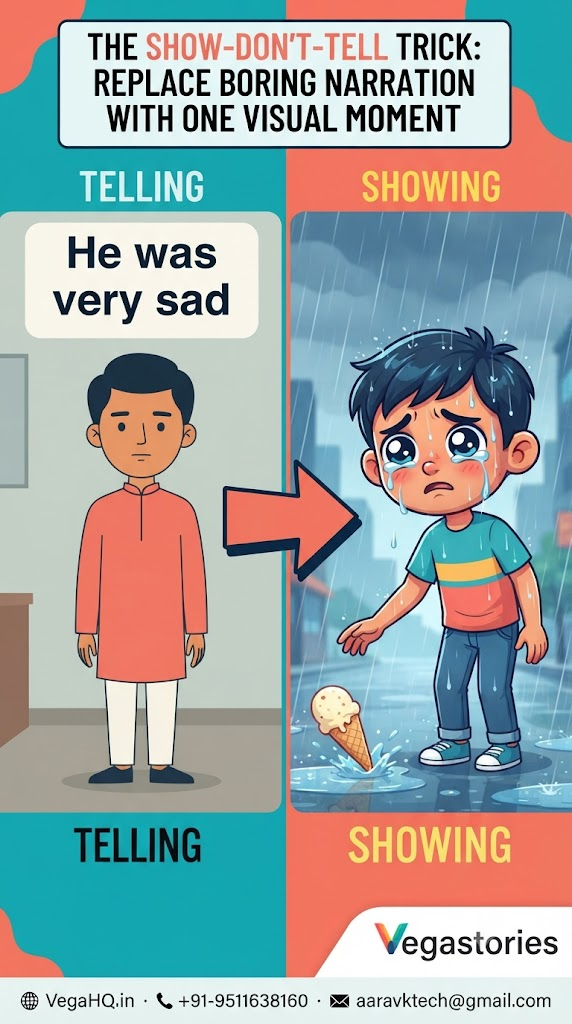
The Show-Don't-Tell Trick: Replace Boring Narration With One Visual Moment
Here's a storytelling tip you can apply to your very next piece of content — and it will instantly make it more powerful. The rule is simple but transformative: stop telling your audience how to feel, and start showing them with a single visual moment. It's the difference between content people scroll past and content people actually feel.
01The "Telling" Trap
When we set out to tell a story, our instinct is to state emotions directly. "He was very sad." "The customer was frustrated." "It was a joyful celebration." It feels efficient — you're getting the point across. But here's the problem: telling people how to feel is flat and forgettable. The audience registers the words but doesn't experience anything. They nod, feel nothing, and move on. You've labelled an emotion instead of creating one.
02The Power of Showing
Now watch what happens when you show instead. Compare these two versions. Telling: "He was very sad." Showing: His ice cream slips from the cone and splatters on the wet pavement in the rain. His lip quivers. A single tear rolls down. Notice something remarkable — the second version never once uses the word "sad." And yet, everyone who reads it feels it completely. That's the magic of show-don't-tell. A specific, vivid image does what a hundred adjectives cannot: it makes the audience feel the emotion themselves.
03How to Apply It Today
Here's your simple action plan. First, go through your story or content and find a spot where you're telling an emotion — phrases like "she was proud," "they were excited," or "he felt lonely." Second, replace that statement with one concrete visual moment that proves the emotion. For "she was proud," maybe she's holding her first pay cheque with both hands, eyes shining. Third, cut the narration entirely and let the picture do the feeling. Trust your audience to understand.
04One Image Beats Ten Words
This principle works across every format — a brand story, a product advertisement, or a social awareness message. A single strong, specific image almost always outperforms a line of explanation, because it invites the audience to feel rather than simply be told.
Showing emotion through vivid visual moments is exactly what we do best at Vegastories.
👉 Want stories that show instead of tell? Create with Vegastories today.
Give HR its AI upgrade
Attendance, payroll, performance and recognition — unified, automated and always in sync.
Comments
Join the conversation — share your thoughts below.
Be the first to comment.