The Under-the-Hood SQL Query Optimization That Cuts HRMS Report Generation Times from 45 Seconds to 0.2 Seconds
Discover how backend database indexing transforms HR report generation from 45 seconds to 0.2 seconds.
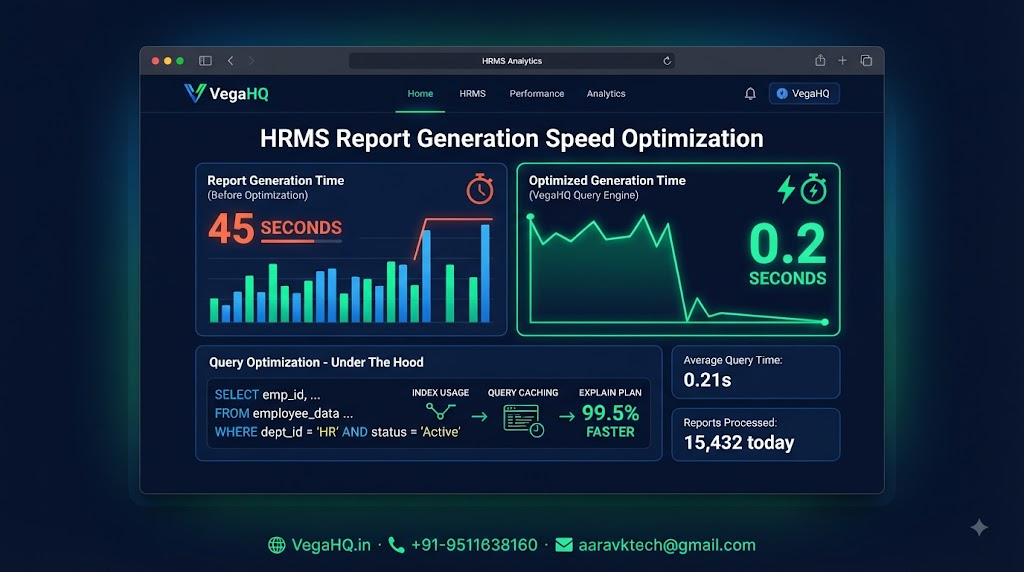
The Hidden Engine Room Behind Instant Enterprise HR Reports
When evaluating a workplace platform, most buyers focus entirely on surface-level aesthetics. They test the button layouts, check the color scheme, and click through the onboarding wizard. But there is a silent performance metric that ultimately dictates whether an administrative team loves or hates their software: query execution speed.
Have you ever clicked generate on a multi-branch payroll summary and sat staring at a spinning loading wheel for nearly a minute? That latency is not just annoying; it kills administrative momentum. Behind every instant dashboard interface lies a complex web of database operations. Today, we are pulling back the curtain on how our engineering team tackled a massive performance bottleneck, reducing heavy enterprise report generation times from 45 grueling seconds down to just 0.2 seconds.
01The Anatomy of a 45-Second Administrative Lag
To understand how to fix a slow reporting engine, you first have to diagnose why legacy systems bog down. When an organization scales past a few hundred employees across multiple locations, data fragmentation becomes a major hurdle. Attendance logs live in one table, shift differentials in another, tax deductions in a third, and leave records scattered somewhere else entirely.
When a user requests a comprehensive monthly summary, a poorly optimized system executes heavy unindexed SQL joins across millions of historical rows. The server has to scan entire tables row by row just to calculate simple totals. Multiply that by multiple concurrent users running separate audits, and your database server CPU spikes to 100 percent capacity, resulting in timeouts, frozen screens, and frustrated HR managers.
02Smart Indexing and Query Restructuring
Our first major breakthrough came from rethinking how we index workforce data. Instead of relying on generic single-column keys, we introduced multi-column composite indexes tailored specifically to common operational query patterns—such as filtering by company branch ID, date range, and employment status simultaneously.
We also eliminated redundant subqueries and replaced them with efficient window functions. By moving heavy computational lifting from the application layer directly to optimized database procedures, we allowed the database engine to locate and aggregate required datasets in memory without performing costly disk I/O operations.
03Caching Hot Workflows Without Stale Data
Speeding up cold database reads is only half the battle. To achieve true zero-latency performance for frequently accessed metrics—such as daily active attendance counts or live shift distributions—we implemented an intelligent, event-driven caching layer.
Instead of querying the core ledger every single time an executive opens the dashboard, the system caches aggregated summaries and invalidates or updates them instantly via background workers the moment a relevant transaction occurs (like an employee checking in via GPS or approving a leave request). This ensures the data remains perfectly accurate while rendering the UI instantly.
04My Take on Choosing High-Performance Workplace Tools
If you are evaluating software for your organization, do not just look at feature checklists during a sanitized vendor demo. Always test the system with heavy loads or ask vendors about their backend architecture. If a platform crawls when handling basic multi-company analytics, it will eventually drain your team time. Investing in platforms built with high-performance scalability in mind is non-negotiable for growing teams.
Administrative software should work at the speed of thought, not at the speed of a legacy server bottleneck. By treating performance engineering as a core feature rather than an afterthought, modern platforms can give HR professionals back hours of lost productivity every single week.
Give HR its AI upgrade
Attendance, payroll, performance and recognition — unified, automated and always in sync.
Comments
Join the conversation — share your thoughts below.
Be the first to comment.