The 2030 Zero-Form Workplace: What If Employees Never Had to Fill an HR Form Again?
Explore the future of HR with VegaHQ's Zero-Form Workplace, where employees never fill out forms again.
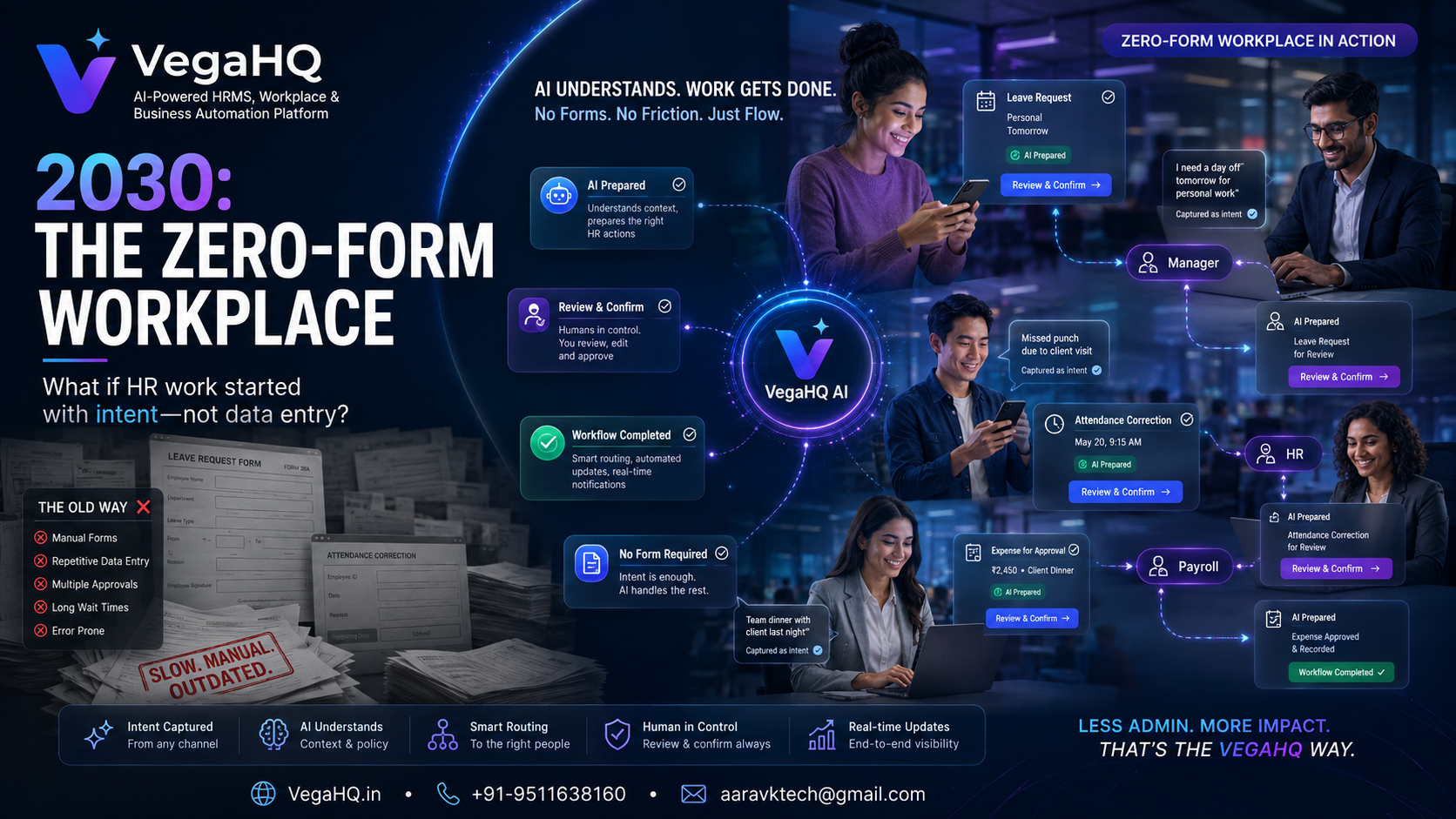
For decades, workplace software has digitized paperwork without completely changing the interaction behind it. Paper leave applications became online leave forms. Printed employee-update sheets became portal screens. Manual requests became digital fields and dropdown menus.
But what if the next evolution isn't a faster digital form? What if it's a workplace where many forms are no longer necessary?
01From Forms to Intent
Imagine an employee needs leave next week. Instead of opening an HR portal, finding the correct module, selecting a request type and entering information, the employee simply communicates the need through an AI-enabled workplace experience.
With appropriate access to workplace data, the platform could identify the employee, interpret the request, prepare relevant dates and workflow information, and present a completed action for review. The employee confirms it, and the request moves to the appropriate manager.
The interface shifts from 'enter everything' to 'review what has been prepared'.
This is the idea behind VegaHQ's Zero-Form Workplace vision.
02AI Should Remove Repetition, Not Human Control
A zero-form experience doesn't mean every HR decision becomes autonomous. Important workplace actions can still require employee confirmation, manager approval, HR oversight or other controls.
AI's role is different: understand intent, use permitted context, prepare routine information and reduce unnecessary steps.
Consider an attendance correction. Instead of requiring an employee to manually reproduce information already available in attendance records, an intelligent platform could surface the relevant event and prepare the correction request. The employee reviews the details and submits it for approval.
The same interaction model could influence employee information updates, routine workplace requests and other repetitive operational workflows.
03HRMS Becomes an Invisible Operating Layer
Traditional business software asks users to understand how the software is organized. Employees learn modules, menus, forms and processes.
Future workplace platforms could increasingly understand what users are trying to accomplish instead.
That would change the role of HRMS. Rather than functioning mainly as a destination employees visit to perform administrative tasks, it could become an intelligent operating layer connecting employees, managers, HR teams and business workflows in the background.
VegaHQ already brings employee management, attendance, payroll, leave, recruitment, performance, communication, approvals, reports, analytics and automation into one web and mobile platform. Connecting these areas creates the foundation for more contextual, AI-assisted experiences.
04What Could 2030 Feel Like?
The most advanced workplace of 2030 may not look dramatically more complicated. It may actually feel simpler.
Employees could spend less time navigating software. Managers could receive concise, context-rich actions instead of incomplete requests. HR teams could spend less time fixing repetitive data-entry problems. Connected workflows could move information between workplace processes while preserving appropriate approvals and oversight.
The ultimate measure of intelligent workplace technology may therefore be how much technology employees don't have to think about.
The Zero-Form Workplace is a vision of that future: software that moves closer to human intent while keeping people in control of consequential actions.
VegaHQ is building an AI-powered HRMS, Workplace and Business Automation platform for organizations ready to streamline operations and accelerate digital transformation. The future isn't another form to complete. It's a workplace that already understands what needs to happen—and helps you make it happen.
Give HR its AI upgrade
Attendance, payroll, performance and recognition — unified, automated and always in sync.
Comments
Join the conversation — share your thoughts below.
Be the first to comment.