The Timesheet Time Sink: How VegaHQ Turns a 6-Hour Weekly Excel Ritual Into a 6-Minute Auto-Generated Report
Discover how VegaHQ's automated timesheets save hours weekly and reduce errors for HR teams.
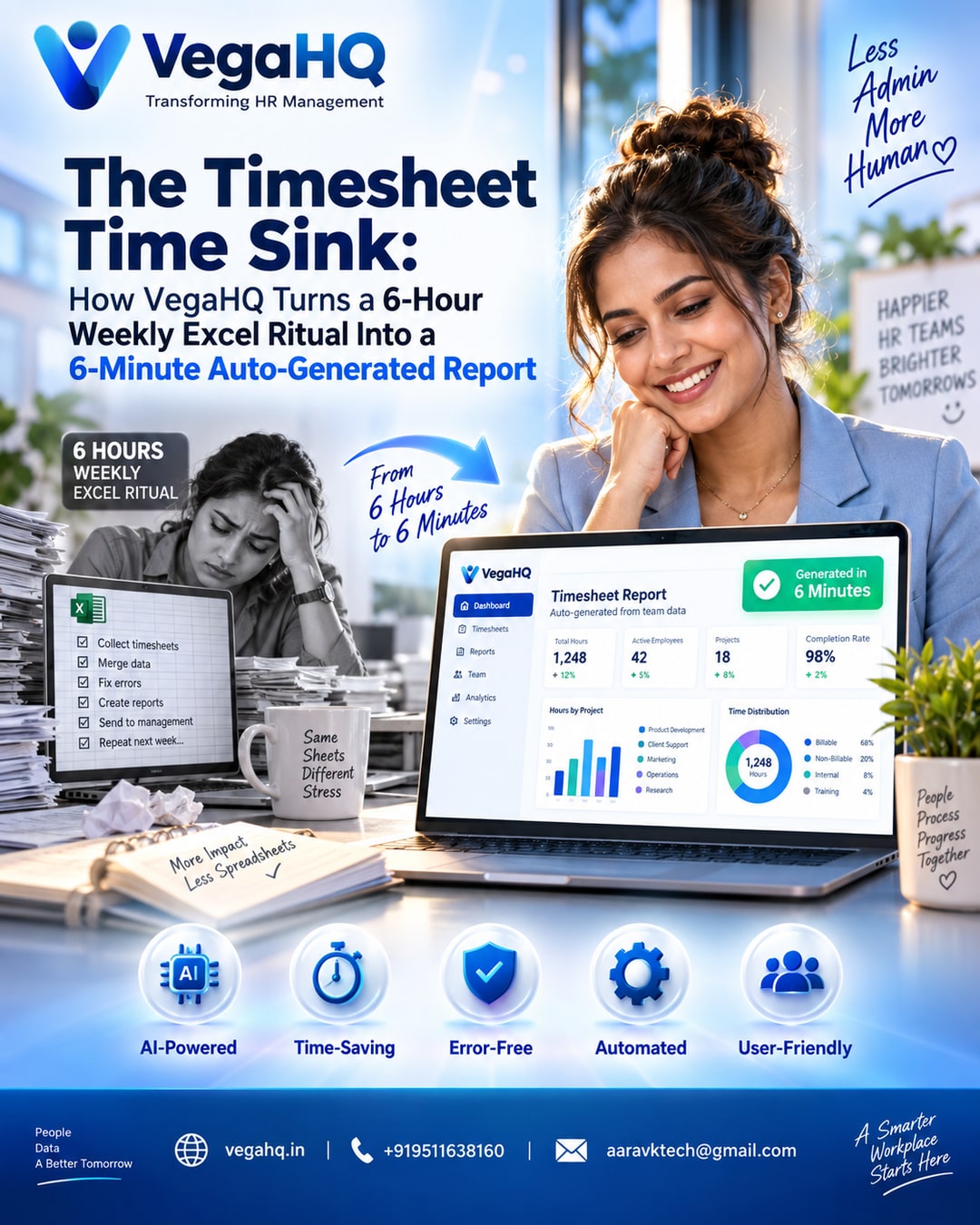
The Timesheet Time Sink Nobody Talks About in HR
Every Friday, somewhere in your office, someone is opening a spreadsheet, cross-checking attendance logs, chasing three employees for missing hours, and manually calculating totals before payroll can even begin. It's one of those tasks that never shows up on a budget line, yet it quietly eats a full workday every single week. This article walks through why manual timesheets cost more than they seem to, and how automated timesheet generation changes the math entirely.
01Why manual timesheets cost more than they look
A single HR coordinator or team lead spending even 5-6 hours a week on timesheet reconciliation adds up to over 300 hours a year. That's nearly two full months of paid work spent on data entry instead of actual HR work. Add in the cost of billing disputes for project-based teams, and the real price tag climbs fast.
02Where the errors actually creep in
Most timesheet mistakes don't come from bad intentions, they come from manual re-entry. An employee clocks in on a biometric device, that data gets copied into a spreadsheet, then again into payroll software, and each transfer is a chance for a typo or a missed row. By the time payroll runs, small errors have already snowballed into real rupee differences on paychecks.
03How automated timesheets close the gap
VegaHQ's approach is simple: instead of recreating attendance data by hand, timesheets are auto-generated directly from GPS attendance and shift logs already captured in the system. Hours are calculated automatically, overtime is flagged, and the report is ready to review and approve in minutes rather than hours. For teams billing clients by the hour, that also means invoices go out faster and with fewer disputed line items.
04What this actually saves a growing business
Take a 50-person company where two HR staff spend 6 hours weekly on timesheets combined. That's 12 hours a week, or roughly 600+ hours a year, that automation can hand back. At even a modest hourly cost, that's a meaningful chunk of salary spent on a task software can do instantly and more accurately.
05Is this only useful for large teams
Not really. Smaller businesses often feel this pain more, since there's rarely a dedicated payroll department to absorb the workload. A 10-person startup founder manually building timesheets on a Sunday night is losing time that should go toward actually growing the business.
My take: if your team is still building timesheets in Excel or on paper, the ROI on switching isn't theoretical, it shows up in your very first pay cycle. For small teams, even a lighter automation setup pays for itself within a month. For larger, project-based teams billing clients by the hour, the accuracy gains alone are worth the switch, since fewer disputes means faster payments. Either way, this is one of the easiest wins in HR automation, and it's worth doing before you fix anything else.
Give HR its AI upgrade
Attendance, payroll, performance and recognition — unified, automated and always in sync.


Comments
Join the conversation — share your thoughts below.
Be the first to comment.