Employee Offboarding Showdown: Manual Exit Paperwork vs VegaHQ's Automated Clearance Workflow
Switch to VegaHQ's automated offboarding workflow and save HR teams days per exit.
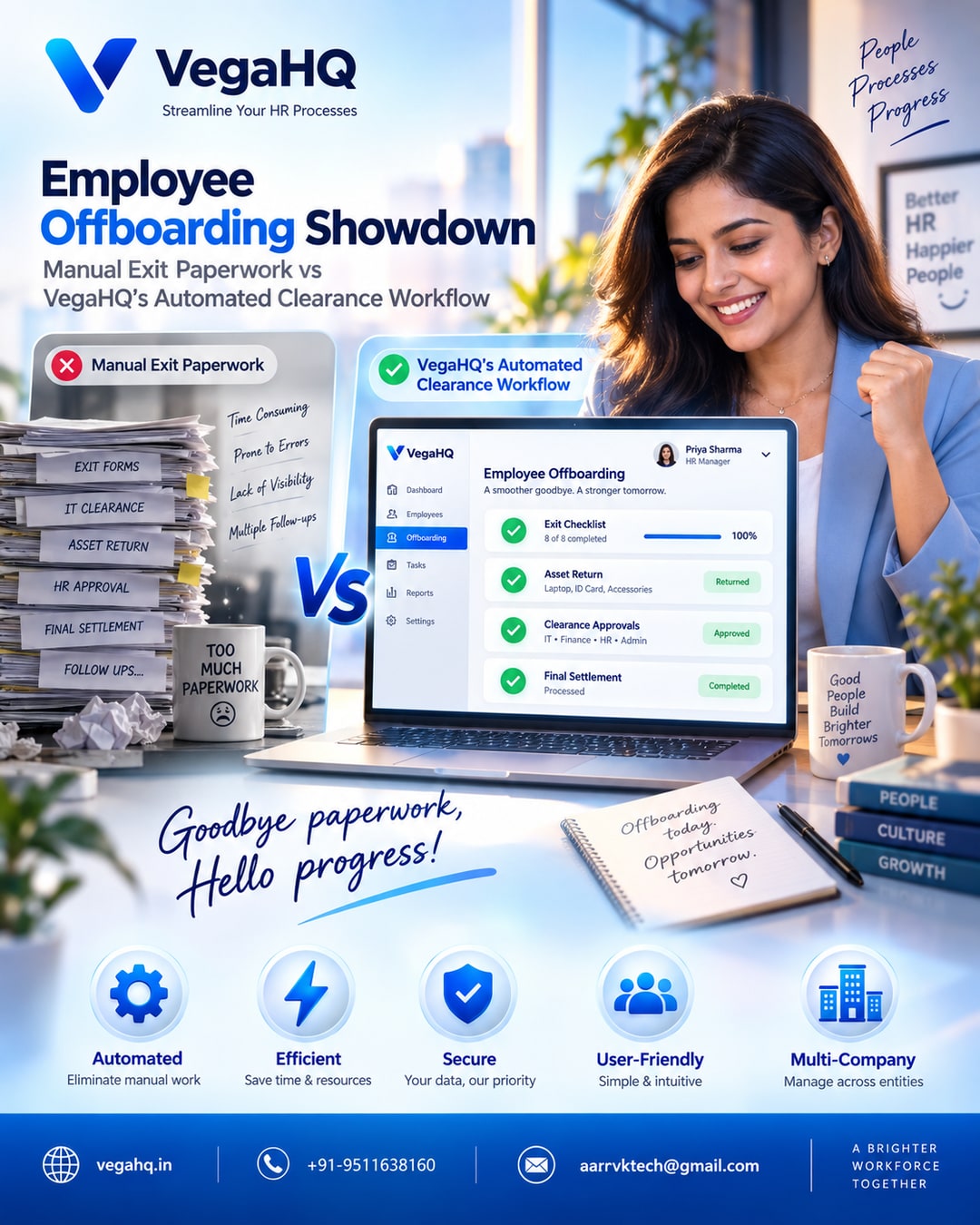
The Hidden Mess Behind Every Employee Exit (And How to Fix It)
Every company obsesses over onboarding - the welcome kits, the buddy systems, the first-day checklists. But ask any HR manager about offboarding, and you'll usually get a sigh. If you're still relying on paper clearance forms and email threads to manage exits, this comparison of manual offboarding vs an automated HR workflow will show you exactly what you're losing.
01Why the manual exit process breaks down
When an employee resigns, the manual process typically looks like this: HR prints a clearance form, the employee physically walks it to IT, Finance and Admin for sign-offs, someone tracks laptop and ID card returns in a spreadsheet, and full and final settlement gets calculated separately, often weeks after the last working day. Each handoff is a place where things get delayed, lost or simply forgotten - and a missing asset or unpaid dues can turn into a legal headache later.
02What automated offboarding actually looks like
With a platform like VegaHQ, initiating an exit triggers a structured workflow automatically. The system generates a checklist covering asset return, access revocation, department-wise clearance and pending dues - and routes each item to the right approver instantly. Nothing sits in someone's inbox waiting to be noticed. HR can see, in real time, exactly which exits are stuck and why.
03The real cost of a messy exit
A drawn-out offboarding process isn't just an internal inconvenience. Delayed final settlements damage your employer brand right when a departing employee is most likely to talk about their experience publicly. Unreturned assets quietly eat into company costs. And forgotten access revocations are a genuine security risk - a common gap that automated HR platforms are specifically built to close.
04Onboarding and offboarding deserve the same rigor
Most companies invest heavily in first impressions and almost nothing in last ones. But a smooth, professional exit process protects the company's data, assets and reputation just as much as a strong hiring process protects culture. Treating offboarding as an afterthought is a gap that's easy to fix once you see it clearly.
My take: if you're a small team of under 20 people, you can probably survive on a shared checklist template for now - just make sure someone owns it end to end. But the moment you're managing exits across multiple departments or locations, manual tracking becomes a liability, not a convenience. That's the point where a platform like VegaHQ, which automates the entire exit workflow from asset return to final settlement, pays for itself in the very first quarter. It's a small feature to evaluate, but it says a lot about how seriously an HR platform takes the full employee lifecycle - not just the exciting parts.
Give HR its AI upgrade
Attendance, payroll, performance and recognition — unified, automated and always in sync.
Comments
Join the conversation — share your thoughts below.
Be the first to comment.